
Navajo History in the United States
The Spaniards brought sheep and horses which the Navajo adapted to their nomadic lifestyle. It is thought that the Navajo originally consisted of four clans and today has expanded to include over 60.
The introduction of Anglo Americans soon led to a treaty between Navajos and the United States Government. The army held all Navajos responsible for all treaty promises, instead of recognizing them as distinct tribal units who made differing decisions.
Finally the army decided to gather all the Navajo people and send them to Fort Sumner.
Kit Carson rounded up the Navajos, though many hid near such locations as Canyon de Chelly and Navajo Mountain.
The Dineh refused to surrender, despite Carson destroying their crops and sheep, burning their villages, and killing their families.
Those who survived were sent to Fort Sumner on the "Long Walk," during which approximately 200 Navajos died due to starvation and cruel treatment.
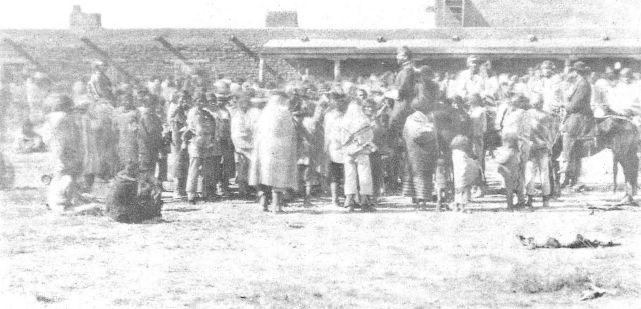
Navajos in 1863,near Fort Sumner, New Mexico at internment camp Bosque Redondo.
Fort Sumner was bitterly disliked by the Navajos who were unable to grow food in the barren land.
They felt betrayed by the white man who forced them to leave the area between their four sacred mountains, area which today comprises the Navajo reservation.
The Peace Commission and the Treaty of 1868 allowed
the Navajo to return to their land after four terrible years. The Navajo were
still tormented, but slowly began to make progress as an individual people,
and today carry on their traditions and unique way of life.